
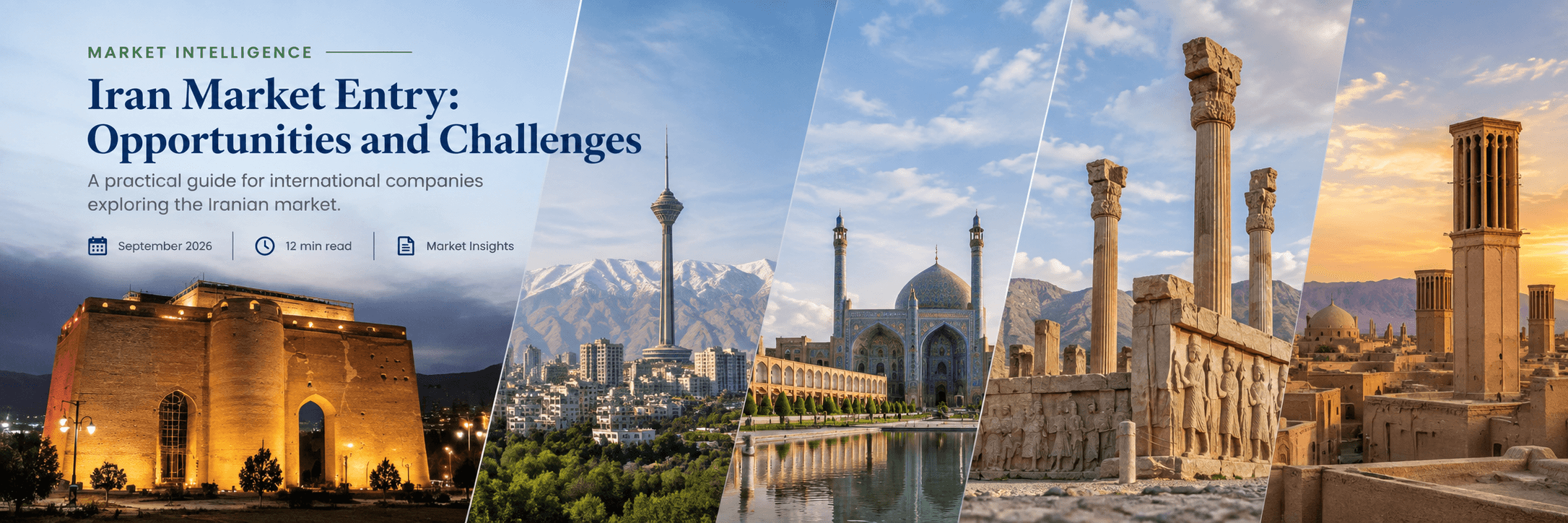
Iran Market Entry: Opportunities and Challenges
Dr. Behzad Aghakhanlou
PhD in International Law | International Trade & Business Professional
Iran presents an unusual proposition for international companies. It is a large and diversified market with an established industrial base, substantial demand for imported inputs and technology, a strategic geographic position between the Middle East, Central Asia, the Caucasus and South Asia, and long-standing commercial connections with Türkiye, the United Arab Emirates, China and Europe. At the same time, it is one of the more complex markets in which to structure an international transaction. Sanctions, export controls, banking constraints, inflation, exchange-rate volatility, import regulation and counterparty risk can transform what appears to be an attractive commercial opportunity into a difficult or unworkable transaction.
This combination makes simplistic descriptions of Iran misleading. Describing the country merely as a “high-risk market” overlooks the volume of legitimate commerce that continues to take place. Describing it simply as a “high-opportunity market” is equally incomplete because market demand alone says little about whether a foreign supplier can lawfully sell a product, receive payment, obtain regulatory approvals, deliver the goods and manage its contractual exposure.
The more useful question for an international company is therefore not whether Iran is, in the abstract, a good or bad market. It is whether a legally permissible, commercially viable, financially workable and operationally manageable entry model exists for the particular company, product and transaction under consideration.
That distinction is fundamental.
Iran remains meaningfully connected to international trade. World Trade Organization data report merchandise imports of approximately USD 68.6 billion in 2024 and merchandise exports of approximately USD 56.0 billion. The same dataset identifies the United Arab Emirates, China and Türkiye among Iran's leading import origins, with Türkiye accounting for approximately 16.3% of imports.[1]
Those figures illustrate an important point. Sanctions have not eliminated Iran's foreign trade. They have changed its geography, financial architecture, counterparties, transportation routes, compliance requirements and transaction costs. Consequently, the existence of substantial trade should not itself be interpreted as evidence that a proposed transaction is permissible. Conversely, the existence of extensive sanctions should not automatically be interpreted as meaning that every form of trade with Iran is prohibited.
The commercial opportunity therefore has to be examined at the level of the individual transaction. For many foreign suppliers, the strongest opportunities are not necessarily found in discretionary consumer products. Iran has a significant domestic production economy, and that economy creates continuing requirements for machinery, spare parts, industrial components, chemicals, additives, raw materials, packaging, production equipment and specialized technologies. Existing industrial capacity requires maintenance and replacement even when investment conditions are difficult. This can produce durable B2B demand, although machinery, components and technology can also raise export-control issues depending on their specifications, origin and end use.
Healthcare and pharmaceuticals constitute another important but particularly regulated field. Demand may exist for medicines, pharmaceutical ingredients, medical equipment, diagnostic products and healthcare technologies, but commercial demand is only the first layer of the analysis. Product registration, licensing, import eligibility, local representation, foreign-exchange arrangements, customs requirements and sanctions classification may all need to be resolved before a transaction becomes executable.
The sanctions position of medicines and medical products also requires more precision than is sometimes assumed. It is incorrect to reduce the issue to the statement that “medicines are exempt from sanctions.” U.S. rules contain authorizations and licensing mechanisms for qualifying agricultural commodities, medicines and medical devices, including mechanisms associated with the Trade Sanctions Reform and Export Enhancement Act of 2000 and the Iranian Transactions and Sanctions Regulations.[2][3]
OFAC guidance further explains that non-U.S. persons generally do not face U.S. secondary-sanctions exposure merely for qualifying sales of agricultural commodities, food, medicine or medical devices to Iran, while important restrictions remain concerning designated persons and other elements of the transaction.[4]The U.S. framework also contains specific general licenses addressing certain humanitarian trade transactions involving particular Iranian financial institutions.[5]
The distinction matters commercially. A pharmaceutical product can be humanitarian in nature and still require careful analysis of the product classification, exporter, manufacturer, financial institution, Iranian purchaser, beneficial ownership of counterparties, payment route and any persons involved in transportation or financing.
The same transaction-specific approach is necessary in industrial trade. U.S. export controls can follow goods, software and technology beyond the territory of the United States. The U.S. Bureau of Industry and Security states that a license from BIS is required to export or reexport most items on the Commerce Control List to Iran pursuant to § 746.7 of the Export Administration Regulations. BIS requirements operate alongside OFAC-administered restrictions under the Iranian Transactions and Sanctions Regulations.[6][7]
Accordingly, the relevant question is not simply, “Can this product be sold to Iran?” A meaningful compliance review asks a much longer sequence of questions:
Product → Origin → Technology → Counterparty → Ownership & Control → Bank → Payment → Shipping → End User → End Use
Changing one element can change the risk analysis of the entire transaction. The product may be unrestricted but the buyer may present a sanctions problem. The buyer may be acceptable but its beneficial owner may not be. The product and buyer may both pass screening while the proposed bank refuses the payment. A distributor may be commercially reputable but unable to establish a transparent end-user chain. A European-manufactured product may incorporate U.S.-origin technology or components that require a separate export-control analysis. A transaction may therefore fail at a point far removed from the commercial negotiation between seller and buyer.
European companies face their own regulatory framework. EU restrictive measures concerning Iran include Council Regulation (EU) No 267/2012 of 23 March 2012, which has been amended repeatedly and remains part of the current legal framework.[8]The framework was amended again in 2026, illustrating why a transaction should be checked against the version actually in force at the time rather than against an old sanctions summary.[18]
At the same time, EU–Iran commerce has not disappeared. According to the European Commission, total EU trade in goods with Iran amounted to approximately €3.7 billion in 2025, comprising approximately €3.0 billion of EU exports and €0.8 billion of EU imports. Two-way trade in services totalled approximately €1.6 billion in 2024.[9]
This coexistence of trade and restrictions demonstrates why a binary “sanctioned/not sanctioned” conception of the Iranian market is inadequate. Compliance has to be performed against the actual transaction and against the legal regimes applicable to the companies, goods, technology and financial institutions involved.
It also explains one of the most important distinctions in Iran-related business:legal permissibility is not the same as practical bankability.
A transaction can survive a legal sanctions analysis and still be commercially impossible because no suitable financial institution is willing to process it. Banks make their own compliance and risk decisions. Those decisions may be more conservative than the outer boundary of what the law technically permits. Correspondent banking relationships, internal Iran policies, transaction-monitoring requirements, documentary standards, beneficial-ownership concerns and the cost of enhanced due diligence can all affect whether a bank is prepared to participate.
The problem is reinforced by Iran's AML/CFT status. In February 2026, the Financial Action Task Force continued to identify Iran as a High-Risk Jurisdiction Subject to a Call for Action and reiterated its call for effective countermeasures. FATF's Iran country page also records a June 2026 high-risk-jurisdiction publication concerning Iran.[10][11]
This does not mean that every payment connected with Iran is unlawful. It means that the payment architecture cannot safely be treated as an administrative detail to be addressed after a sales contract has been signed. For Iran-related transactions,payment feasibility should be tested before commercial commitment and certainly before shipment.
A supplier that negotiates the product, price, delivery date and exclusivity arrangements first and asks how payment will actually be received only at the end has reversed the appropriate order of analysis.
The same principle applies to currency and pricing. A foreign supplier may quote in euros or another stable contractual currency, but its Iranian buyer operates in an environment where the local-currency cost of the transaction can change materially between quotation, order registration, payment, shipment, customs clearance and resale. The result can be a commercially sound order at the date of quotation that becomes economically unattractive by the time the importer has to complete the transaction.
International companies therefore need to think about pricing as a risk-allocation mechanism rather than merely a number on a quotation. Depending on the transaction, useful contractual tools may include shorter quotation-validity periods, clearly identified contract currencies, staged payments, lawful advance-payment structures, price-adjustment mechanisms, allocation of newly imposed customs or governmental charges, and clauses addressing delays caused by banking or regulatory restrictions. This is especially important for products with long manufacturing or regulatory lead times.
Foreign suppliers should also avoid confusing market demand with importability. An Iranian customer may genuinely want the product and possess the financial resources to purchase it, yet the transaction may still depend on product eligibility, registration, sector-specific approvals, order registration, import licensing, standards, labeling requirements, customs classification, foreign-exchange rules or authorization by a specialist regulator.
Market Demand → Product Eligibility → Regulatory Approval → Import Structure → Customs → Distribution
Skipping the middle stages creates one of the most common forms of false market opportunity: strong customer interest in a product that cannot be imported under the proposed structure.
Consumer markets require a similar degree of caution. Iran's population and geographic scale can create substantial headline market potential, but population is not the same as addressable purchasing power. Imported consumer goods ultimately have to absorb currency movements, transportation costs, tariffs, customs expenses, regulatory costs, distributor margins and retail margins. Import restrictions can further change the commercial equation.
The relevant market size for a foreign supplier is therefore not the total number of consumers. It is the number of consumers who can realistically purchase the imported product at itslanded and distributed price.
In B2B sectors the analysis is different. An industrial buyer may purchase an expensive imported component because failure to replace it would stop a production line. A pharmaceutical importer may pursue a specialized medicine because local alternatives do not satisfy a particular requirement. A manufacturer may continue purchasing an imported intermediate input because reformulating its product or changing its production process would be more costly than the import.
Iran is consequently not one market. Pharmaceuticals, industrial machinery, raw materials, consumer products, professional services and productive investment each present different combinations of opportunity, regulatory exposure, payment risk and sanctions sensitivity.
Türkiye occupies an especially important position in this commercial landscape. The two countries share a long land border and established transportation and commercial relationships. Official Turkish data report bilateral trade of approximately USD 5.68 billion in 2024, consisting of about USD 3.23 billion of Turkish exports to Iran and USD 2.45 billion of imports from Iran. Türkiye's principal exports to Iran include machinery and parts, plastics, various chemical products, agricultural products and metal ores.[12]
For European and other international suppliers, Türkiye can therefore have genuine operational relevance. Turkish companies may contribute logistics, procurement, regional market knowledge, commercial coordination and access to established trade routes. But this requires an essential qualification: Türkiye can be a commercial gateway. It is not a mechanism for making sanctions obligations disappear.
Routing goods through Türkiye does not change their underlying origin where origin is legally relevant. It does not automatically remove U.S. export-control jurisdiction over items subject to the EAR. It does not make a designated end user acceptable, cure a prohibited end use or convert an impermissible transaction into a permissible one merely because a Turkish intermediary has been inserted into the supply chain.[6][7]
A Turkish intermediary should therefore have a real commercial function and should be incorporated into, rather than used to avoid, the compliance architecture of the transaction.
The choice of the Iranian local partner is equally important. A capable local partner can provide knowledge that is difficult to reproduce remotely: regulatory navigation, product registration, customs practice, distribution, customer relationships, local documentation, after-sales support and knowledge of how a particular sector actually operates. But those advantages create dependency.
An international supplier should therefore resist granting exclusivity merely because a prospective distributor presents attractive sales projections. Before exclusivity, the supplier should establish who the counterparty actually is, who owns and controls it, whether the person signing has corporate authority, whether sanctions concerns exist, whether the company has relevant regulatory permissions, whether it possesses sufficient financial capacity and whether its claimed distribution network and customer relationships are real.
Due diligence first. Exclusivity second.
The distribution agreement should then convert commercial expectations into measurable obligations. Territory, product scope, exclusivity, minimum purchases, performance targets, registration responsibilities, marketing, use of trademarks, confidentiality, compliance obligations, sub-distributors, reporting, termination rights, post-termination treatment of registrations and inventory, governing law and dispute resolution all deserve attention.
This becomes particularly important where the local distributor performs product registration in its own name or acquires control over regulatory assets necessary to keep the product on the market. A foreign supplier that fails to address the ownership, transfer or post-termination use of those rights at the beginning of the relationship may discover that changing distributor later is substantially harder than changing a conventional commercial agent.
Dispute resolution should likewise be designed before a dispute exists. The question is not merely which governing law appears familiar to the foreign supplier. The parties should consider where assets are located, where an award or judgment may need to be enforced, whether the chosen dispute mechanism remains operational if banking or sanctions restrictions intensify, and whether interim protection might be required.
Foreign direct investment introduces another layer of analysis. Iran has a statutory framework for foreign investment under its Foreign Investment Promotion and Protection Act. UNCTAD's Investment Laws Navigator reproduces the 2002 foreign investment law and records that “foreign capital” can include cash, machinery and equipment, spare parts and components, raw materials and additives, patents, technological know-how, trademarks and specialized services.[13]UNCTAD's Iran country navigator also lists the 2002 law within the country's investment-law framework.[19]
Yet the existence of an investment statute answers only one question: whether a legal framework for foreign investment exists. A serious investor must ask several additional questions:Can we invest? Can we finance the investment? Can the business operate? Can profits or capital be transferred? Can equipment and technology lawfully be supplied? Can the investment survive currency instability? And can we exit?
A theoretically available investment structure may therefore be less attractive than direct export, while in another sector local production or a joint venture may solve commercial and regulatory problems that cannot efficiently be solved through repeated imports.
There is no universally superior Iran-entry structure. Direct export provides relatively limited commitment but may leave the foreign supplier dependent on an importer. A distributor can provide immediate local infrastructure but creates counterparty and exclusivity risk. Agency may preserve greater commercial control while raising different legal and operational questions. A joint venture can align interests but substantially increases governance and exit complexity. Local production may reduce certain import constraints but requires much deeper commitment. Foreign investment can create long-term positioning but brings capital, repatriation, sanctions and operational issues to the forefront.
The correct structure therefore follows the transaction rather than preceding it. A practical market-entry process begins with market screening. The company should identify the actual customer segment, competitive landscape, expected landed price, local alternatives and realistic sales volume. This stage should be capable of producing a negative answer. Market-entry analysis that is designed only to justify a predetermined decision to enter the market is not analysis.
The next stage is legal and sanctions screening. The product, origin, technology, exporter, intermediary, purchaser, beneficial owners, banks, transportation parties, end user and end use should be examined against the legal regimes applicable to the transaction. For U.S.-linked transactions, this can include OFAC and BIS rules; EU companies must consider applicable EU restrictive measures as well as relevant national implementation requirements.[14][8]
This screening should not be performed once and forgotten. Sanctions designations, general licenses, suspensions and other regulatory measures can change. OFAC's current Iran sanctions page, for example, lists multiple Iran-related general licenses and identifies several 2026 suspensions and other actions.[14]
The third stage is regulatory mapping. Before significant commercial expenditure is incurred, the company should identify the authorities, approvals, registrations, licenses, standards, labeling rules and import procedures applicable to its specific product.
The fourth is partner due diligence. Corporate identity, ownership, signing authority, sanctions status, financial capacity, regulatory capability, commercial track record and actual distribution resources should be verified rather than assumed.
The fifth is entry structuring. Only after the earlier work should the company decide whether direct export, distribution, agency, joint venture, local production or another structure best fits the opportunity.
The sixth is contract and payment architecture. The commercial agreement, compliance provisions, pricing mechanism, currency, payment method, banking feasibility, delivery terms, allocation of regulatory responsibility, termination rights and dispute mechanism should operate as one system rather than as unrelated contract clauses.
Finally, where commercially possible, the company should pilot before scale. A limited initial transaction can test regulatory timing, payment execution, customs procedures, distributor performance, actual demand and logistics. The information obtained from a successful first shipment can be more valuable than a highly optimistic five-year sales forecast.
This staged approach is particularly appropriate because Iran-related compliance is not static. OFAC maintains a substantial Iran sanctions framework under which the legal treatment of a transaction can depend on the parties, activity, applicable prohibition, exemption, general license or specific authorization.[14]Where specific authorization is required, OFAC maintains a licensing process and dedicated application guidance.[16]
The humanitarian-trade framework is likewise active rather than merely historical. In January 2026, OFAC published a TSRA licensing-activity report covering July through September 2025 and confirmed that it processes applications to export agricultural commodities, medicine and medical devices to Iran under the TSRA specific-licensing regime.[17]
European measures have also evolved repeatedly. The current EUR-Lex material for Council Regulation (EU) No 267/2012 records later consolidated versions and a current version dated 1 August 2026, reinforcing the need to verify the legal text applicable at the time of a transaction.[8]The July 2026 amending regulation provides a recent example of that continuing evolution.[18]
Financial-compliance conditions can also change. FATF has acknowledged Iran's renewed engagement and updates concerning international conventions, while continuing in 2026 to state that Iran remains subject to its call for countermeasures.[10]
For that reason, no market-entry memorandum, sanctions screening or partner review should be treated as permanently valid. There is another consequence for international companies:compliance must be documented, not merely performed.
A company should be able to reconstruct why it concluded that a transaction was permissible, which entities were screened, what ownership information was obtained, how the product was classified, what end-use information was received and which legal rules or licenses were relied upon. Where a transaction is humanitarian, the company should preserve the information supporting that characterization rather than assuming that the nature of the product will be self-evident later.
This is particularly relevant to pharmaceuticals and medical devices. OFAC's TSRA materials define the scope of medicines and medical devices by reference to applicable statutory definitions and distinguish qualifying products from ordinary equipment used in medical environments.[3]OFAC has also issued specific regulatory updates concerning medical supplies under the Iranian Transactions and Sanctions Regulations, demonstrating why classification should be based on the applicable rules rather than a general assumption that anything used by a hospital necessarily receives the same treatment.[20]
The broader lesson applies beyond healthcare. The most successful Iran-entry strategy is unlikely to be the one that ignores complexity. It is the one that identifies complexity early enough to price, structure and manage it.
Iran offers genuine commercial opportunities. Its continuing import volumes demonstrate substantial foreign trade; its industrial economy creates requirements for machinery, components and inputs; healthcare generates specialized demand; and its commercial relationship with Türkiye remains significant.[1][12]
But opportunity is not enough. A foreign company entering Iran without sanctions screening may discover that its counterparty or end use is unacceptable. A company that performs sanctions screening but ignores banking may have a lawful contract and no workable method of receiving payment. A company that solves payment but neglects product registration may have goods that cannot be imported. A company that clears regulation but selects the wrong distributor may lose commercial control of the market. A company that solves all of those issues but prices without accounting for currency and timing risk may complete transactions that generate sales but destroy margin.
These are not independent risks. They interact.
That is why Iran market entry should not begin with the question, “How do we sell into Iran?” It should begin with a more disciplined sequence:
For some products, that process will produce a commercially attractive route into the market. For others, it will show that the opportunity should be postponed, restructured or rejected. Both outcomes represent successful market-entry analysis.
The objective is not to make Iran appear easier than it is, nor to treat complexity as a reason to dismiss the market altogether. The objective is to determine, transaction by transaction, whether commercial opportunity can be converted into lawful, bankable and operationally sustainable business.
References
[1] World Trade Organization, WTO Tariff & Trade Data — Iran Member Profile. 2024 merchandise trade data, including total exports, imports and principal trading partners. Official source
[2] U.S. Department of the Treasury, Office of Foreign Assets Control, Trade Sanctions Reform and Export Enhancement Act of 2000 (TSRA) Program. Official source
[3] Office of Foreign Assets Control, TSRA Program Information, including definitions and guidance concerning agricultural commodities, medicine and medical devices. Official source
[4] Office of Foreign Assets Control, Frequently Asked Question 844, guidance on secondary-sanctions exposure of non-U.S. persons in certain humanitarian-related transactions involving Iran. Official source
[5] Office of Foreign Assets Control, Selected General Licenses — Iran Sanctions, including Iran General License 8A and Iran General License L. Official source
[6] U.S. Department of Commerce, Bureau of Industry and Security, Iran Export Controls. Official source
[7] U.S. Department of Commerce, Bureau of Industry and Security, Export Administration Regulations, 15 C.F.R. § 746.7 — Iran. Official source
[8] Council Regulation (EU) No 267/2012 of 23 March 2012 concerning restrictive measures against Iran and repealing Regulation (EU) No 961/2010, as subsequently amended and consolidated. EUR-Lex
[9] European Commission, Directorate-General for Trade and Economic Security, EU Trade Relations with Iran, including 2025 goods-trade and 2024 services-trade data. Official source
[10] Financial Action Task Force, High-Risk Jurisdictions Subject to a Call for Action — 13 February 2026, Iran section. Official source
[11] Financial Action Task Force, Iran Country Page, including the 19 June 2026 high-risk jurisdiction publication. Official source
[12] Republic of Türkiye Ministry of Foreign Affairs, Türkiye–Iran Economic and Commercial Relations, including 2024 bilateral trade data and principal traded product categories. Official source
[13] United Nations Conference on Trade and Development, Investment Policy Hub, Iran, Islamic Republic of — Law on Encouragement and Protection of Foreign Investment, Official Gazette No. 16,709 (2002). UNCTAD
[14] U.S. Department of the Treasury, Office of Foreign Assets Control, Iran Sanctions — program page containing regulations, guidance, general licenses and current Iran-related actions. Official source
[15] Office of Foreign Assets Control, OFAC Legal Library — Federal Register Notices, official notices concerning sanctions regulations and amendments. Official source
[16] Office of Foreign Assets Control, OFAC License Application Page, procedures for requests for specific authorization where applicable. Official source
[17] Office of Foreign Assets Control, Report for Licensing Activities Undertaken Pursuant to the Trade Sanctions Reform and Export Enhancement Act (TSRA), 21 January 2026, covering July–September 2025. Official source
[18] Council Regulation (EU) 2026/1867 of 30 July 2026 amending Regulation (EU) No 267/2012 concerning restrictive measures against Iran, Official Journal of the European Union, 31 July 2026. EUR-Lex
[19] United Nations Conference on Trade and Development, Investment Policy Hub, Iran, Islamic Republic of — Country Navigator, investment laws and policy measures. UNCTAD
[20] Office of Foreign Assets Control, Update to the Iranian Transactions and Sanctions Regulations, 2 November 2015, concerning medical supplies under 31 C.F.R. § 560.530. Official source
Last reviewed: September 2026.
This article is intended for general informational purposes only. It does not constitute legal, sanctions, regulatory, tax, financial or investment advice. Sanctions, export-control and regulatory requirements are subject to change and should be assessed for the specific parties, products, jurisdictions, financial institutions, end users and end uses involved in each transaction.